Recently I came to a convicting realization recently with the help of a friend. If I’m painting with a broad brush, I’d suggest that effective math classrooms have three things in place:
- Quality mathematical tasks
- Effective facilitation
- Social and emotional safety
I’m not sure if there’s a rank-order of the importance of these ingredients to a successful math classroom, but let’s just say that they have equal weight: a third, a third, a third.
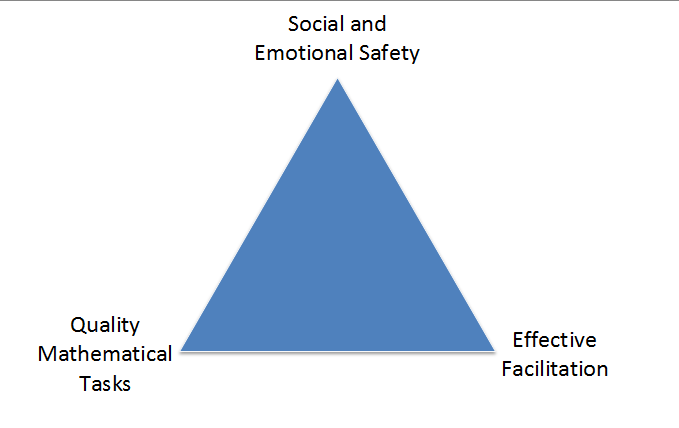
As I look at my own posts, others’ posts that I’ve bookmarked and favorited, and where I spend most of my time, it looks roughly like this.

I’d give it a 60%-30%-10% split, and that 10% might even be generous.
In other words, social and emotional safety is something I rarely think about, and even more rarely blog about. In Jo Boaler’s “How To Learn Math” course, she shares interviews with former math students who exhibit signs of trauma. That’s the word she and they use: trauma. While I think most math teachers that I read and follow probably understand the need for developing a safe place emotionally and socially for the classroom, it’s something I don’t come across that often. Much of that is my own fault. I spend most of my time blogging and talking about cool, engaging tasks and nifty facilitation moves. I don’t spend much time at all trying to flatten the spoken and unspoken social structures that crop up in nearly all classrooms. Part of this is that it’s actually much harder work to do that than designing a cool task based around an article or something. It’s also something that really can’t be modeled in a few-hour single PD session.
It’s also probably in part because I’m a dude. This post on the prevalence of males and math tasks has been lodged in my brain like a tumor. I can forget about it for a few days at a time, but every now and then it’ll pop up and I’m reduced to a stammering mess. I hope I’m not gender-norming when I suggest males tend to be more in to designing tasks and “troubleshooting” student engagement and less adherent to the social and emotional component accompanied with mathematics classrooms, which is just as if not more important than the other ingredients. I certainly have spent 10-to-1 time or more on designing, finding, and thinking about mathematical tasks versus flattening the social status of mathematics learners. Again, the ratio of what makes for a successful math learning experience is off, either in what I’m reading or what’s actually out there. Probably both.
Consider this post part confession, part imploration. My lack of writing on the social and emotional structures is something that has shaken and convicted me. It’s also something that damn hard to find posts on throughout the Math ed blogosphere. Maybe I’m looking in the wrong places, but I am looking and not finding much. Consider this not only an imploration for math bloggers to blog about developing social safety in math classes, but also to share these more often (starting in the comments here, pretty please?).
I can’t promise that I’ll start blogging about how to develop a flatter math classroom as I can’t be sure I’ll acquire any unique insight other than copying and pasting what others have said. But I do plan on making this a huge point of learning for myself this year. I want to read more about developing an emotionally and socially safe math classroom that flattens structures and gives students an in to mathematics. I want to write more about it too.
Update 2/5/2014: Glad I’m not the only one struggling with this. Erica Synder finds a nice analog of the social and emotional safety structures with Digital Learning.
 emergent math