Category: math
-
Specifics before Strategies
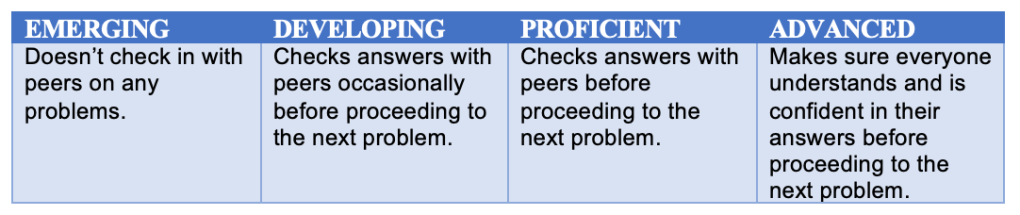
In this blog post, we’ll explore how to get specific with math or non-math classroom issues before we develop strategies. We’ll also see an example of how to build a rubric from the ground up. === “My kids just won’t work together.” This (or something like it) is a common complaint I hear during professional…
-
Your Student Portfolio System Begins Now
As we transition back into School Mode, I’d like to offer a brief encouragement to use this school year to establish a system of student portfolios. If you’d like a “why” around this, I’ll point you to my Shadowcon Talk from a couple years ago. If you’d prefer not to watch a video, here are…
-
Problem Based Learning and supporting English Language Learners
A classroom with quality, complex problems as its cornerstones can support English Language Learners. First let’s check out a few “ground rules” about supporting English Language Learners. The following ground rules are not exhaustive, but are pulled strategically from English Language Learners and the New Standards by Margaret Heritage, Aída Walqui, and Robert Linquanti. Use…
-

What Khan Academy Gets Really, Really Right
There is no shortage of criticism of Khan Academy around these parts. In fact, Khan Academy criticism was among the first unifying themes of the math blogosphere. Since then, however, KA has made their platform more robust and useful. And those of us who swore it off might want to take another look. I’m taking…
-

What teacher training and PD can learn from Trader Joe’s
When we got a Trader Joe’s in our humble little burg of Fort Collins there was much rejoicing. Now we have a place to get all sorts of goodies, which I’ll describe in more detail in a moment. Sadly, due to some byzantine Colorado laws they cannot carry Two-Buck Chuck. Nevertheless, I hit up TJ’s…
-
I’m not sure what the second step is, but the first to understand
Recently I had a conversation with a special education coordinator. He was struggling to keep his kids in their classes. They kept getting sent out for disruptive behavior, being off task, or not playing well with others. He talked about parents who would leave IEPs in tears. These meetings – and other informal meetings –…
-
Active Caring, a how-to
I’ve given the book talk (by other names) a few times now, and I’m noticing some patterns of what’s really resonating. One small, but significant piece that’s fostering conversation is a section around Active Caring vs. Passive Caring. I’ve blogged a bit about this in the past, so feel free to check out those posts. There appears…
-
Mathematical play, but, like, for older kids
Chris and Melissa gave a great talk on the importance of mathematical play at NCTM-Seattle last week. You can see their Math-on-a-Stick work on their website. There you can see pictures and examples and of children enjoying and playing with math in interesting and delightful ways. One of my many takeaways from their keynote was…
-
Active Caring (and Epilogue): the essential ingredient
This is a post in the ongoing Emergent Math mini-series: Routines, Lessons, Problems, and Projects. As we stand on the balcony and gaze out at our own version of the MCU (Math Class Universe) that consists of Routines, Lessons, Problems, and Projects, we must be sure we’re not missing the crucial ingredient that stitches it…
 emergent math