This is the landing page for a school year’s worth of warm-ups centered around 5th grade standards. The positive reception of my Algebra Warm Ups for Geometry Teachers inspired me to continue to help teachers understand and address the gaps that come with students who are transitioning between content or, as is often the case in 6th grade, schools. You can read more about in my explainer post but the short version is this: math teachers need to assess and address prior student knowledge. This is particularly acute in 6th grade as content gets more complex and students are in a new environment. Well crafted warm ups are a way engage and reveal student thinking in a quick, low-stakes manner.
Below you’ll find warm ups centered on 5th Grade topics for every day for 36 school weeks.
There are both Google Doc versions and Google Slide versions linked on the planning document. You may also wish to print out a warm up recording sheet for students.
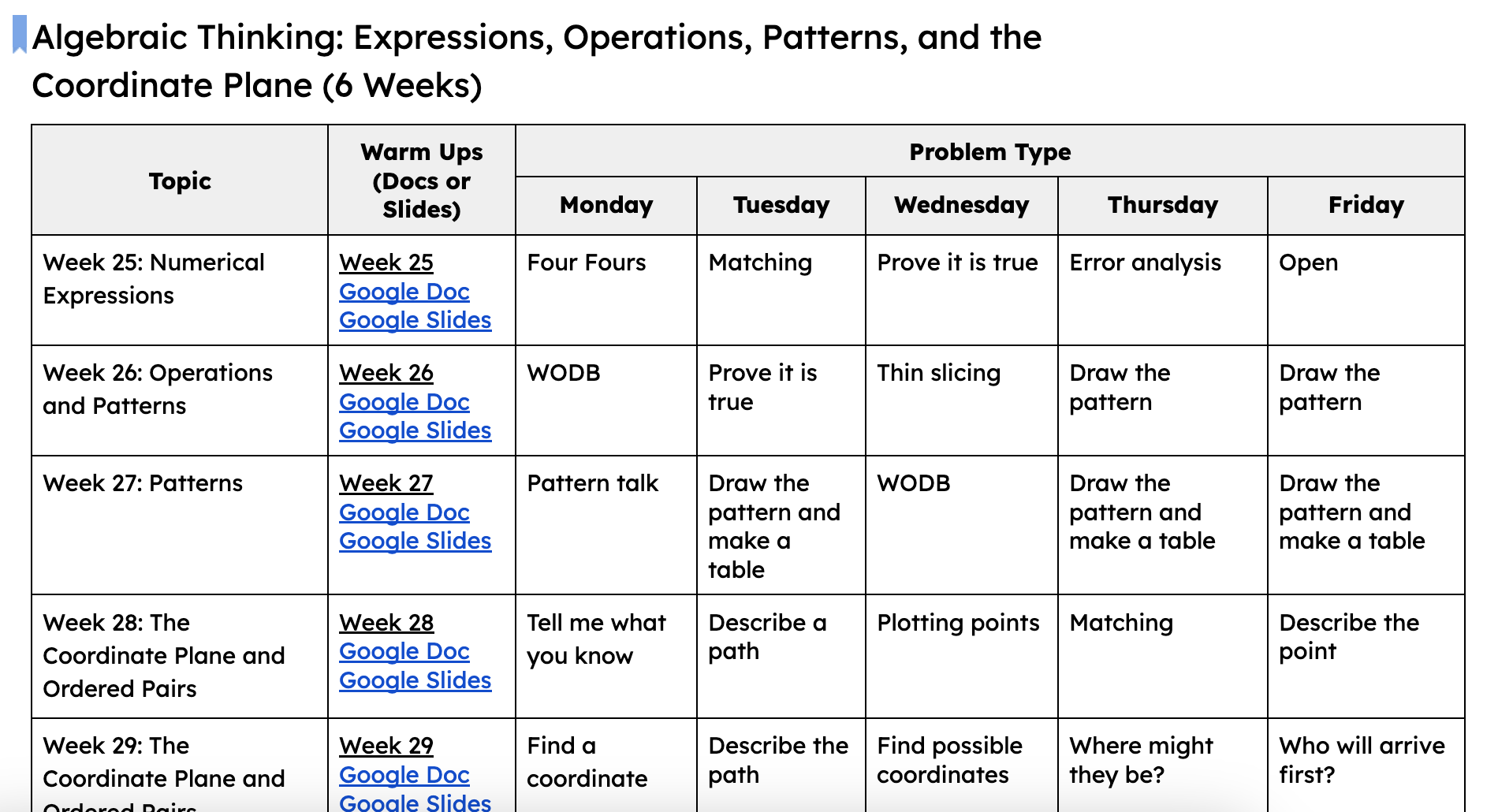
The planning document and accompanying matrix showcases the topics and the types of problems. The warm ups showcase a variety of problem-types that you may wish to imbue into your regular teaching practice. These problem types include all-access tasks such as “Which One Doesn’t Belong?”, Number Talks, Pattern Talks, “Tell me what you know”, Notice and Wonder, matching, thin slicing, error analysis, and many others. While most of the tasks are original, I’d like to shout out the following websites, books, and resources as they offered inspiration for task-types:
- WODB.ca and Which One Doesn’t Belong
- Michael Pershan’s Teaching Math With Examples
- Visualpatterns.org
- Wouldyourathermath.com
- ntimages.weebly.com
- fractle.me
- Openmiddle.com
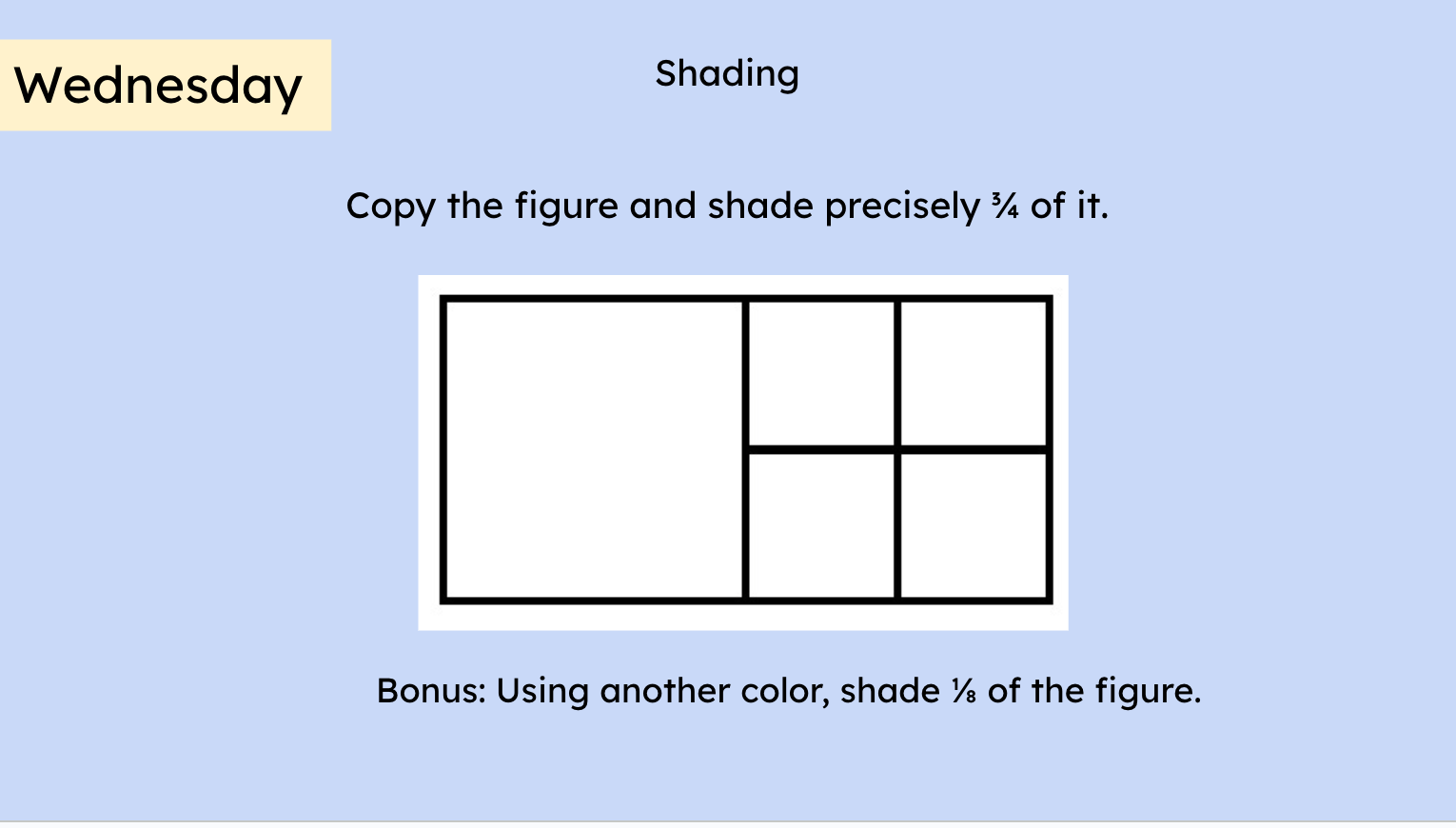
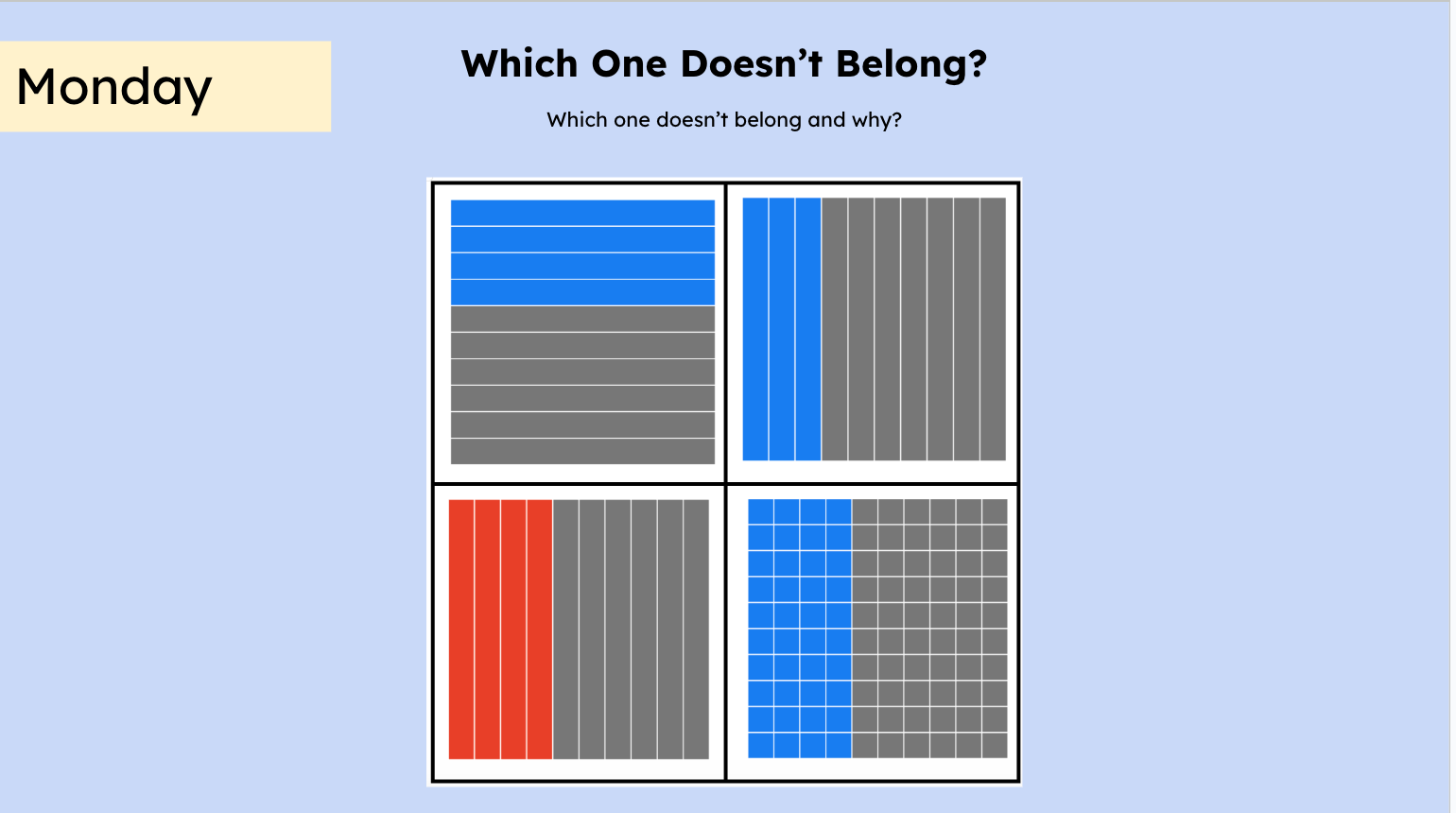
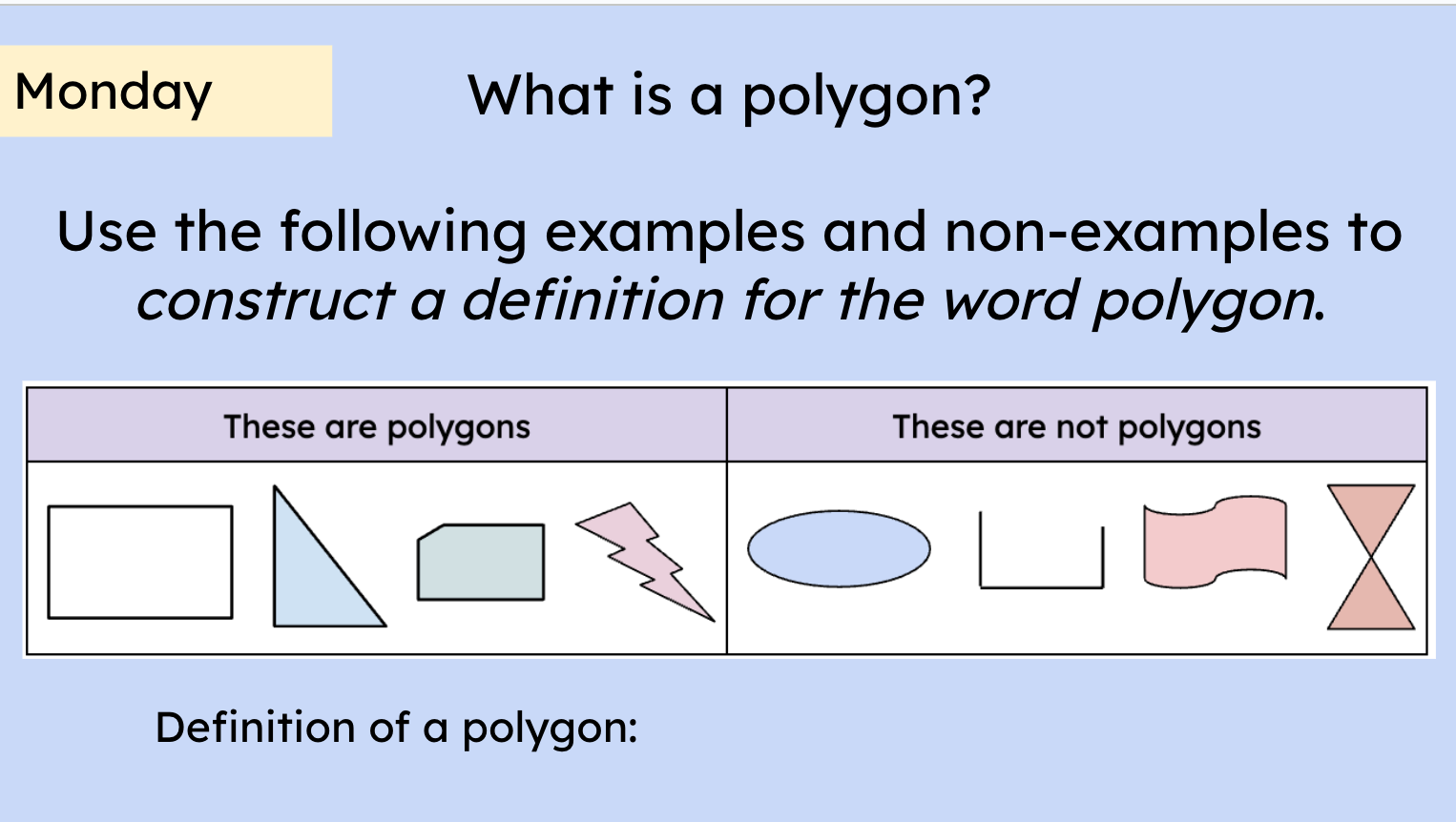

Warm ups occur at the beginning of class, typically taking 3-5 minutes. In my class I have warm ups posted before class starts and have an expectation that students begin work on them immediately upon getting settled into their seats, allowing for some socializing. That expectation occurs from Day 1 and does not stop for even a single school day. You may wish to facilitate them using journals, discussion, or weekly turned-in recording sheets.
While these are intended to be a years’ worth of warm ups, I could envision other uses. You may wish to pull some of the individual problems to incorporate on regular assignments. You could even develop a pre-assessment by cobbling together many of the problem types.
The warm ups are presented in two formats: on viewable google documents and viewable google slides. You may copy them to adapt and use in your class. You’ll find both formats and an outline by clicking the button below.
Some FAQs:
So what is this again?
A bank of quick problems intended to illuminate what 6th grade students know about and can do with mathematics.
OK, so why is this again?
Check out the explainer blog post. Warm ups are a way to activate thinking and what reveal what students know about content. This can be particularly important for 6th Grade teachers trying to figure out what their students remember from 5th grade and before.
I also wanted to illustrate some high leverage task types that teachers may wish to continue to draw upon in the regular instruction. Hopefully there’s a task type or two that’s new to you that you’ll really enjoy!
How many warm ups are there?
Thirty six weeks times 5 days/week = 180 days of warm-ups.
Do you expect me to use all of these? I have, like pep-rally days and random off days.
Of course not! Just like my problem based curriculum maps, you’re probably not going to use all of the tasks. Use the ones you want.
How do I facilitate these warm ups?
My recommendation is to establish an expectation from the first day of school to have students begin to work on warm ups immediately. On the very first day of school I have a warm up. I greet students at the door and welcome them. I then direct them to their assigned seat and tell them to begin working on the task that is on the board/screen. If you’d like, you have have them record their warm ups using this recording sheet. Or they can keep a notebook. It’s up to you!
Should I grade these?
I’ll tell you what I did. I gave an existent, but statistically insignificant grade for warm-ups. Think: 5 points in a week where students may accumulate 150 points. I graded for completion, not correctness. But it’s up to you!
How did you select the topics?
I examined 5th grade textbooks, workbooks, and Common Core State Standards. I also gave some preference to topics that are particularly needed in 6th grade math.
I also added special emphases in two areas: multiplying with the area model and conceptual understanding of fractions. In my experience as a coach, a teacher, and a researcher, these are topics that need to be continually reintroduced throughout a students’ mathematical career. Emphasizing these two topics early on pays big dividends long term.
Are these original problems?
Mostly they are, unless there is a link pointing to the original source.
I’m not a 6th Grade teacher. Can I still use these?
Sure, have at them! They could certainly also serve as an as-you-go set of 5th grade warm ups, or refreshers for 7th grade. I’d argue some of the problems could even merit discourse in a High School class.
Will you update the warm ups?
Maybe, but probably not. At least not for a while.
What about topic X? It’s not in the document and my students should know that from 5th Grade!
Sorry!!
Is there an answer key?
No. Many of the problems are answer-less or have multiple answers. And I encourage teachers to do math with students rather than do math at students. So do the warm ups with students! Maybe you’ll make a mistake! That’s ok!
I’ll add more info to this post as I continue to get questions on them. Feel free to ping me with additional questions or feedback!
 emergent math