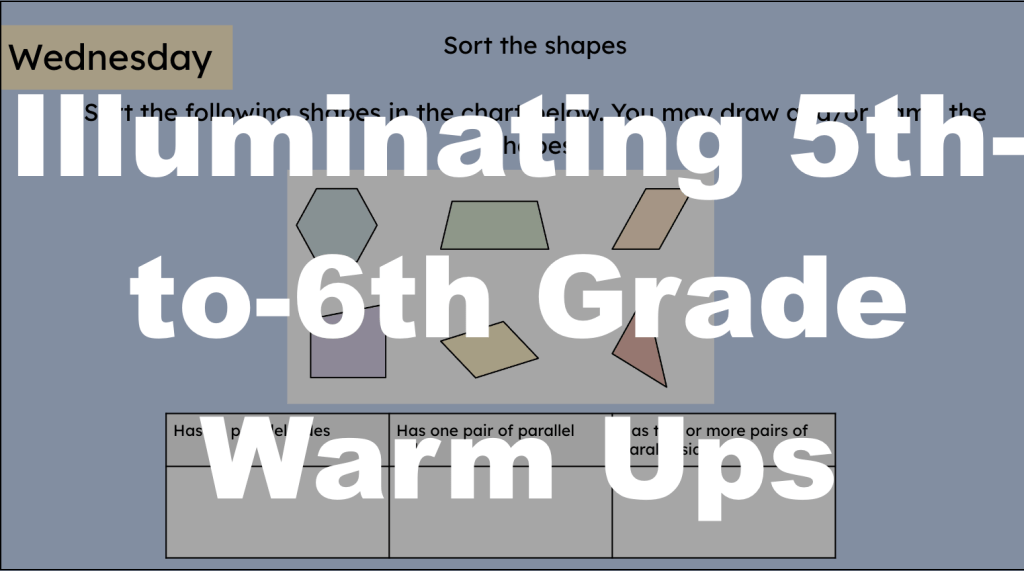
While it’s important at every grade level, 6th grade teachers in particular need tools to let them know what students know about math while revealing new ways for students to be smart in math.
This isn’t exactly breaking new ground, but I’ve been enamored with the opportunity (and often lost opportunity) of the first few minutes of class. A few months ago I had a coaching visit at a school where things were going ok. But my one piece of advice across the board was to incorporate some sort of beginning-of-class routine. It didn’t even really have to be a routine, just something to get the kids thinking.

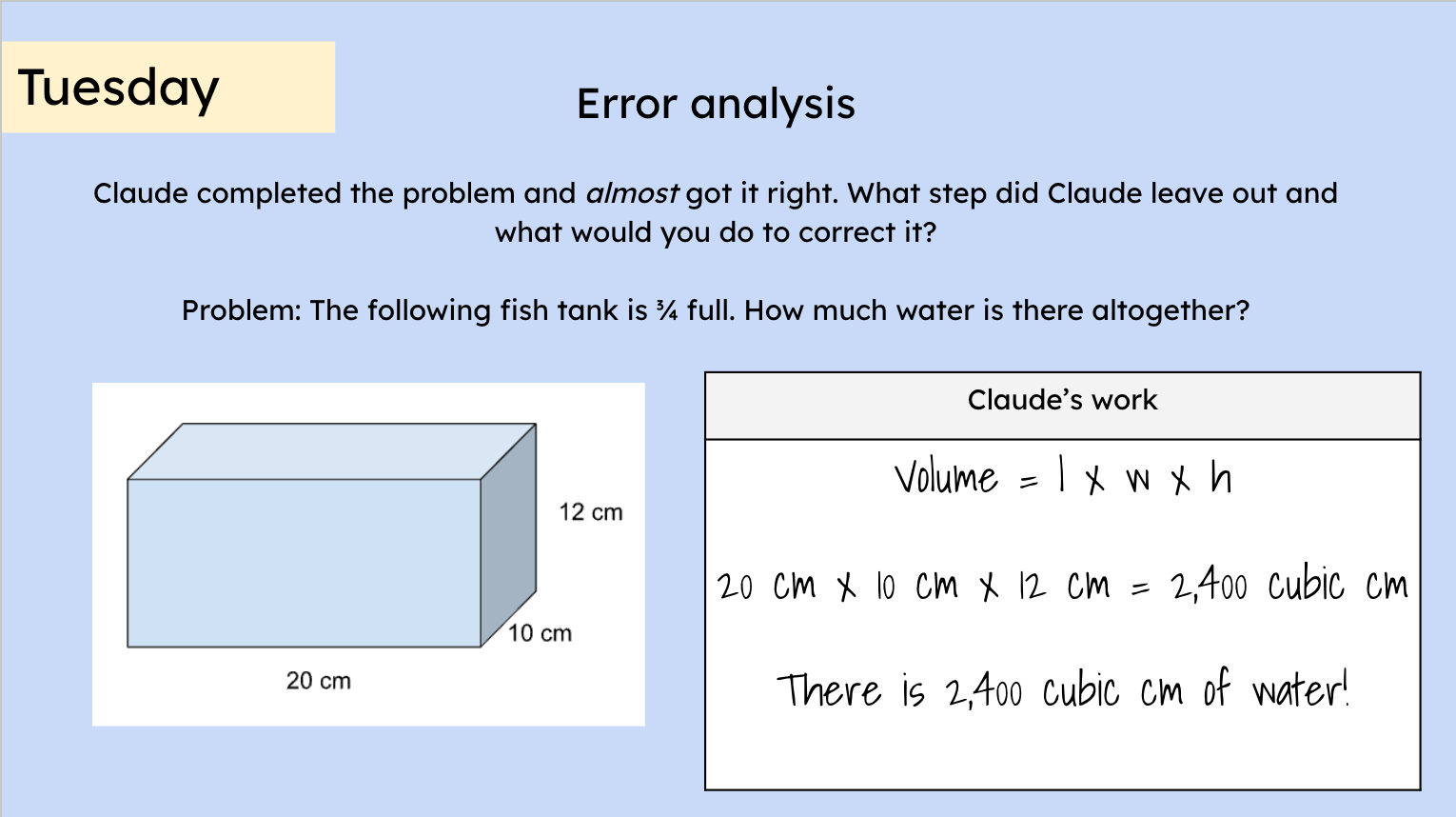
This not-new realization also comes on the heels of some work I did a couple years ago that I’ve gotten wonderful feedback on: my Algebra Warm Ups for Geometry teachers. I had a conversation with a teacher here in Colorado who won an award for math teaching excellence. She specifically credited those warm ups for the evolution in her pedagogy.
While she was certainly being overly nice, that actually comports with one of the best ways I’ve seen advance teacher practice and enhance student thinking: spend the first 5 minutes of class doing fun, interesting, creative, and accessible mathematics. For students, it’s an opportunity to enhance academic status in the classroom with low-stakes, intuition heavy tasks. For teachers, it’s a low-effort way of possibly introducing a new routine or task type.

This brings us to the 5th-to-6th grade transition.
I’ll never forget my first day of student teaching in a 6th grade classroom. It was early in the school year and I was demonstrating some arcane procedure on the overhead projector (shown below if you’ve no idea what that is). Then a student holds up his hand. I ask him what his question is. His response: “I drew you this picture, Mr. Krall.” In reflecting on that moment 25 years later I still recall my inner thoughts: “Oh jeez, these are essentially still 5th graders.” And now, I know I need something to actually let me know what students know about math and reveal new ways they can be smart at math.
Just about every Summer I do some sort of mathematical project. I often write a mini-series as a long form blogging exercise. I also did the aforementioned Warm Ups project. This is my project for this summer: a bank of 180 warm ups geared towards 5th grade standards that will illuminate what 6th grade kids know about math and illuminate ways students can be smart in math. My priorities for designing these tasks were: creativity, accessibility, variety, and no prep work for the teacher. In prioritizing these design principles, I hope to utilize the warm ups in the following manners:
Warm Ups as Diagnostic Tools
In 6th grade the complexity of math ramps up at the same time the students are experiencing a wildly different type of schooling. Complicating matters is the fact that teachers are also new to the students. 6th grade teachers typically can’t walk down the hall and ask the 5th grade teacher about students or covered content. So these warm ups are diagnostic in nature.
Warm Ups as activators of Quality Pedagogy
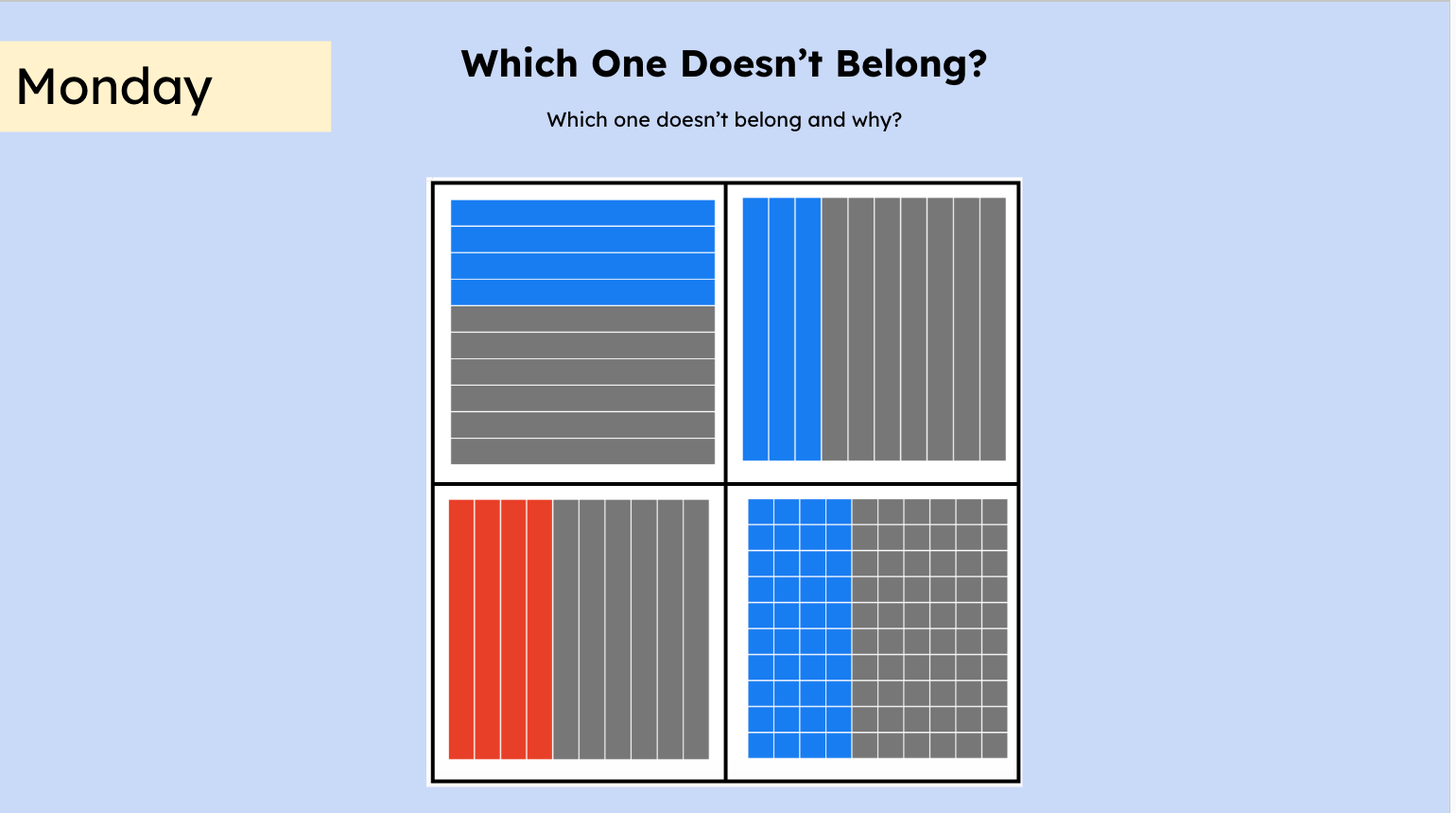
In constructing these tasks, I’ve used a wide variety of task-types. There are discourse routines, matching activities, and a few others I invented or stole. You’ll find a lot of your favorites in this bank of warm ups: Which One Doesn’t Belong, Dot Talks, Number Talks, Would You Rather?, along with more “traditional” routines like matching and sorting. Many of them you’ve probably seen, experienced, or facilitated. Others you may have not. You might find a task type that resonates with you. Hopefully those good experiences will filter into other aspects of instruction.
Warm Ups as activators of Mathematical Identity
One of the essential aspects of warm ups is their accessibility. Every student in the room needs to have access to the task, even if it’s just a start or an entry point. I chose and wrote the warm ups in such a manner that hopefully all students will be able to have access to them. There are tasks that incorporate drawing, argumentation, visualization, intuition, and personal preferences. These are all ways students can access mathematical tasks and experience mathematical smartness.
Warm Ups as Refreshers
Students may not remember, say, the Area Model. Maybe their previous teachers didn’t emphasize it enough or maybe students just plum forgot. Warm Ups are an opportunity to review some of that mathematical understanding that’s in students’ heads, but might require a little excavation to find.

Finally, Warm Ups as low-effort Quality Tasks for Teachers
The last non-negotiable with warm ups is they should take almost no prep work by the teacher. The tasks and prompts should essentially facilitate themselves. They should be clear and quick. A teacher could throw these warm ups on the screen without even looking at them and then be able to think through the tasks with the students.
Final Words: Use them as you see fit
In the same way I chose Algebra warm ups as a high need area, I chose 5th grade math as a high need area. While intended for 6th grade students to experience or review 5th grade math again, there’s no reason a 5th grade teacher couldn’t use these as part of their instruction. A 7th grade teacher may identify fractions as a topic for remediation/refreshment so they might wish to implement all the fractions tasks. There are even tasks that might serve High School teachers well (I mean, what grade level couldn’t use fractions exercises?).


As I hit “publish” on these tasks I send them out into the universe. Use them however you want, in whatever order you want, in whatever grade level you want, and in whatever quantity you want.
I think they’re good tasks and I hope they make your life as a teacher easier and better.
Alright, enough exposition.
Quick links:
5th-to-6th Grade Warm Ups Landing Page
Google Doc Matrix of 5th-to-6th Grade Warm Ups
Warm Up Recording Sheet
 emergent math