As I mentioned last time, the Pythagorean Theorem is a difficult concept to have students discover intuitively. So we’re focusing on it specifically this week. If you have any activities or ideas, please let me know. Or tweet it to me.
Here’s one sent in by Kevin.
========================================
A math nerd (Let’s say her name is Tara) decides that she is going to get a tattoo, and she draws up the following design for the artist to put on her back:

The colored ink costs $3 per square centimeter. Outlining in black is free if the color costs $150 or more. If the color is less than $150, then black outlining costs 50 cents per cm.
Tara wants those squares to form a right triangle like above, where the vertical leg is 5 cm long, and the horizontal leg is 7 cm long.
How much will the tattoo cost Tara? Make sure to write out all of your calculations.
Part 2:
The tattoo artist suggests that to save money, and to make the calculation of cost easier, she make the vertical leg 3 cm, and the horizontal leg 4 cm. How much will this tattoo cost, and why did the artist say it would be easier to calculate?
Part 3:
Tara decides that the above options are too expensive, so she re-designs her idea, like so:

Tara asks vertical leg to be 2 cm, and the horizontal leg to be 3 cm. How much will this tattoo cost (to the nearest half-penny, please)? The letters are free.
Facilitation notes:
The idea with the first two parts is to get students to see a relationship between the blue and red squares, and the yellow square. I anticipate that students will solve the first part by measuring C, so many groups will get slightly different answers. This provides a set-up for part 2. Both tattoos 1 and 2 should have the outlining done for free. The last part is meant to have students determine the length of C, and it creates a need to know that value precisely…which should get to the need for an equation?
========================================
My comments:
- I think the use of graph paper is in order for Parts 1 and 2. It makes measuring and drawing right angles so much easier. And shoot, you can count the number of square cm in the smaller shaded regions.
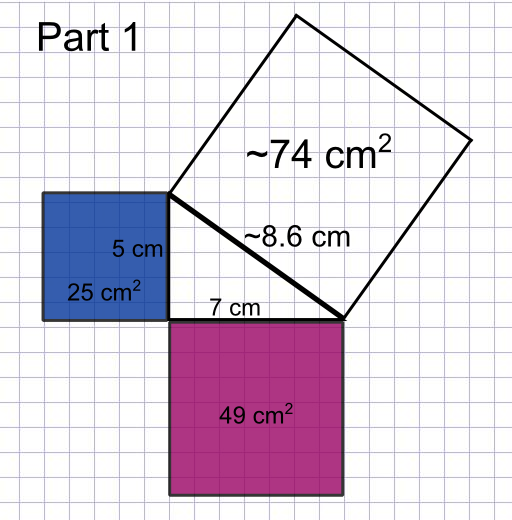
- I’m wondering if it’s better or worse to construct a right triangle with exclusively whole numbers. Any ideas?
- I also wonder if there should be a few more measuring tasks: it’s pretty much the only hope of students discovering the Pythagorean Theorem “on their own”, noting the sum of the areas of the smaller squares equal that of the larger square.
- Should the pricing aspect of the problem be included in Part 1? It may be distracting, but it certainly adds to the authenticity.
What do you think? Please leave any comments you may have in the… comments.
More on the Pythagorean Theorem coming tomorrow. Stay tuned.
 emergent math