Artifacts
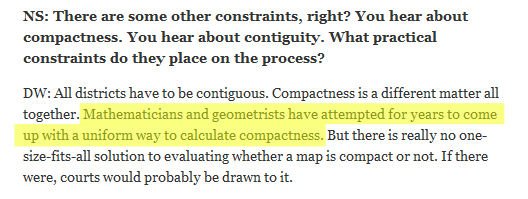
This NY Times article/interview conducted by FiveThirtyEight.com’s Nate Silver and David Wasserman, House editor of the Cook Political Report. Particularly this snippet:
And/or this slideshow from Slate showing the most gerrymandered congressional districts in the nation.
Here’s my favorite from Illinois:
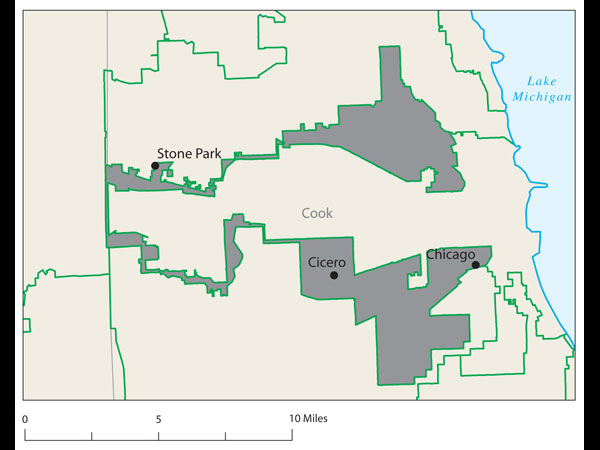
It’s worth noting that by federal law, congressional districts have to be “contiguous.” That means that (apparently) you can have a sidewalk connecting two blobs and you can call that contiguous.
Guiding Questions
- What is gerrymandering?
- Why do political parties do this?
- Do the political parties that gerrymander egregiously like this ever get punished?
- Is this really legal?
- So, how can we measure “compactness”?
- Would our measure of “compactness” yield the same top gerrymandered districts that Slate came up with?
- What are the least gerrymandered districts in the U.S.?
- How do we find the area of irregular shapes?
Suggested activities
- Time to get you maps, compasses, colored pencils, and rulers out, just like Lewis and Clark.
- Have students develop a metric or method to measure the “compactness” of a congressional district, particularly their own.
- Students may want to research a history of gerrymandering, or the gerrymandering that has taken place in their state. I say, go for it. It might cross over into History and Political Science, but that’s definitely a good thing when it comes to HS and MS students.
- The intended audience for such activities could range from politicians to political scientists to community board members. (aside: if you really want to rankle people in the community, I suggest looking at gerrymandering for school zones)
- Assign each group a congressional district and ask them to develop a case for why theirs is the most egregious example of gerrymandering using geometry.
Potential solutions
- While there isn’t necessarily one true, correct solution, it seems to me you could come up with a perimeter-to-area metric to measure the compactness, sort of analagous to the surface area-to-volume ratio that dictates how quickly, say, ice melts.
- Or the centrality of or distance between the population centers. Perhaps analogous to the center of gravity, you can imagine if you were to cut out the shape of a congressional district and add mass by population and location, the more unstable it is, perhaps the less compact it is. (note: this is not necessarily true, but worth investigating)
- Other potential metrics for students to measure: The distance between a population center and the borders of the distrct. Is there a way we could assign a penalty for districts who have conspicuous gaps or, as in the case in Illinois above, a tiny stretch of road (or something) connecting two large areas?
- Ask each group to come up with a congressional district map for their state that is less gerrymandered than it currently is and demonstrate why mathematically. You could certainly envision a scenario in which an actual politician or political scientist may want to sit in on a panel. Certainly, your students can come up with a more mathematically appropriate map of congressional districts than this:
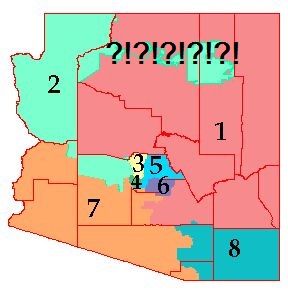
- Note: as for the least gerrymandered congressional districts, that has to be a tie for first place between Wyoming, Montana, etc. because, well, you know….
How else could we measure the compactness and/or the egregiousness of gerrymandering?
 emergent math