emergent math
Lessons, Commentary, Coaching, and all things mathematics.

Emergent Math
Geoff Krall | geoff@emergentmath.com
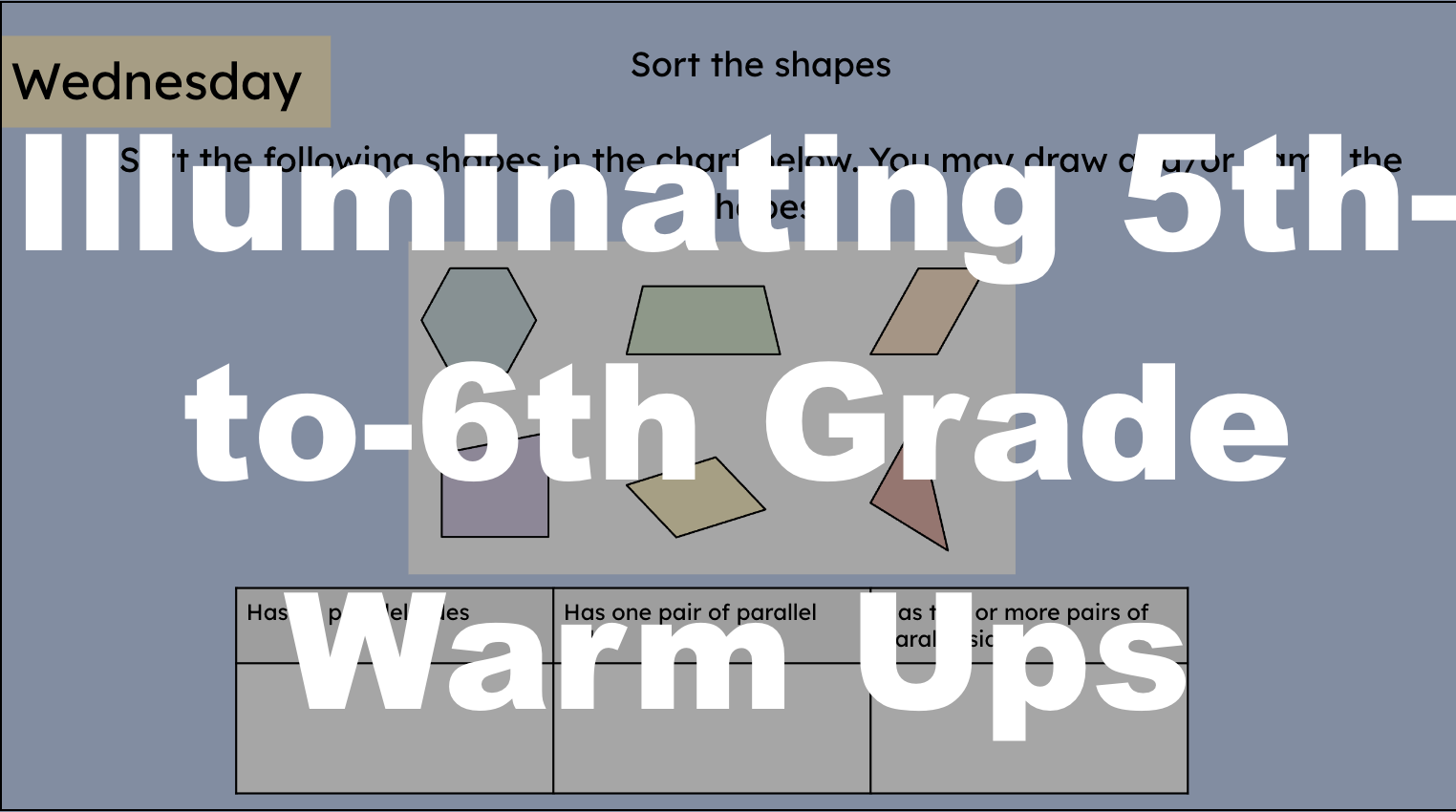
Illuminating 5th-to-6th Grade Warm Ups
Check out 180 complimentary warm ups intended to bridge the gap between 5th and 6th grade!


Algebra Warm Ups for Geometry Teachers
Check out 180 free Algebra warm ups intended to bridge the gap between Algebra 1 and Algebra 2!
Coaching and PD
Want to learn more about how I can support you in-person or virtually? Check out some of my Coaching, PD, and Workshop ideas.
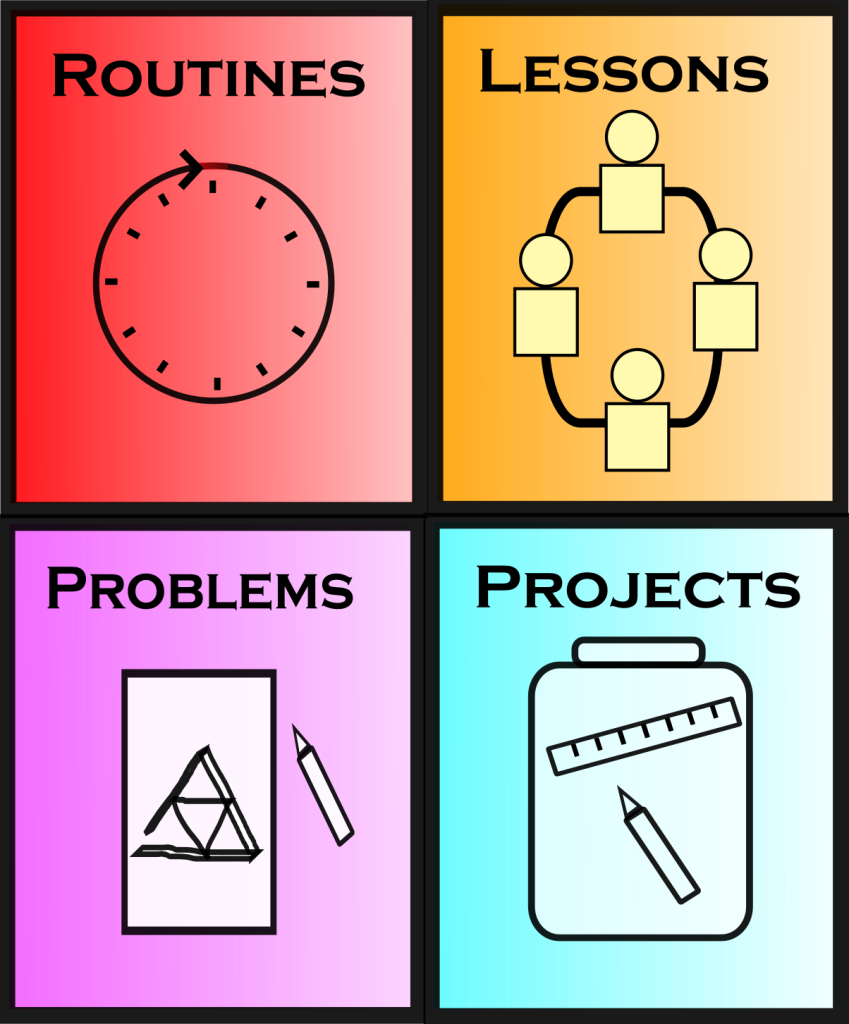
Geoff’s Longform Math Education Miniseries
I’ve done a lot of longform blogging. I call them “mini-series” where I do a deep dive into a particular aspect of math instruction.
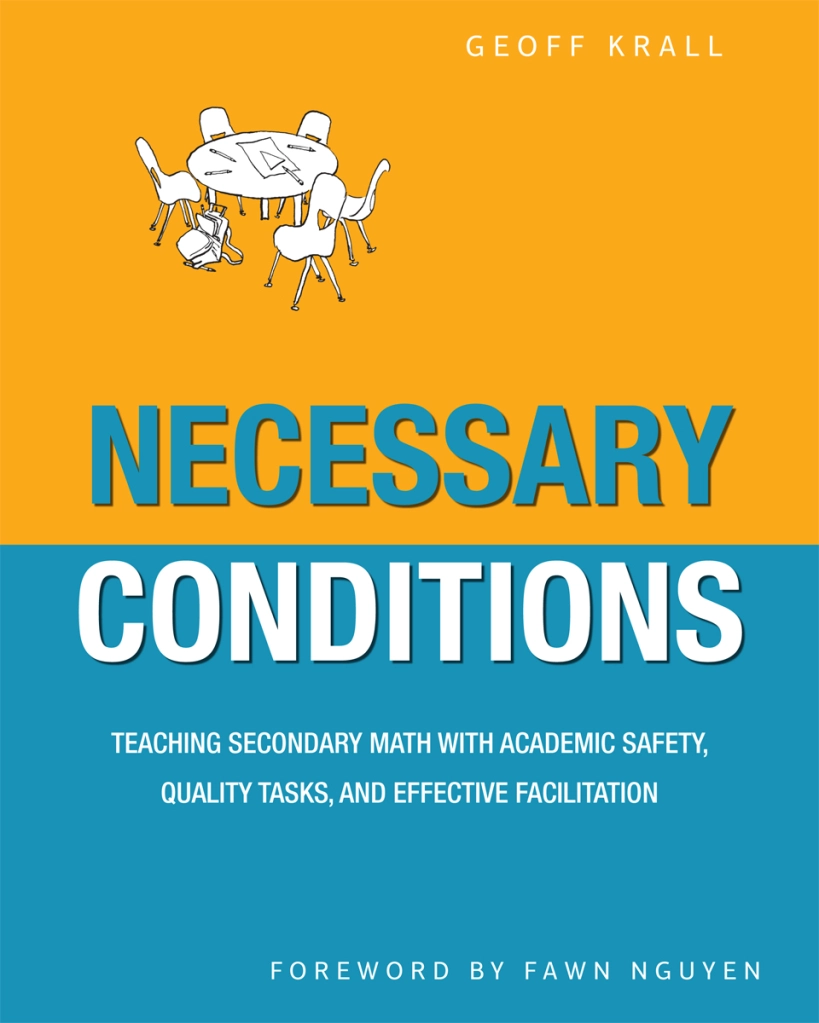
Necessary Conditions
My book about math instruction and accompanying card sets for professional development use.
Feedback from Geoff’s Professional Development
“
“THANK YOU for helping to make teaching math more relevant and helping me feel at ease because I still suck at math but will always continue to learn all I can so as to reach out to more students to help them love math too!”
— Secondary Teacher, Idaho
“
“The resources provided were very helpful and easily applicable! There were several opportunities for participation and conversation that were non-threatening and reflective!”
— MS Teacher, Michigan
From the blog
-

HB 1557 and lines in the sand: Understanding and communicating the purpose of Florida’s “Don’t Say Gay” bill
(This website is about math and math education. While I don’t normally write about Topics of the Day, it’s crucial that parents and educators understand the text and purpose of Florida’s House Bill 1557, which specifically targets teachers and students.) I’ve never been much of a proponent of fleeing a state because you disagree with…
-

What’s the “of” in a percentage grade? A percentage of what, exactly?
What does a 79% mean? This post questions what exactly does a percentage grade tell us, and if we might be mixing units.
-

Academic Safety for Pre-Service Teachers and Other Reflections from the Semester
This has been a unique semester in that I took two courses and taught a course. The course I taught is a one-hour seminar course, “Math for Elementary Teachers,” not to be confused with their “actual” math course, nor their math teaching methods course. This course is a small part of pre-service teachers’ (PSTs) teacher…
-
Musings on Mathematical Creativity
This semester I had to write a literature review of a topic of our choice. Last year I focused on assessment, which will be my dissertation topic. I wanted to try something a little more “lighthearted” this year, so I went with Mathematical Creativity. I’m not going to reproduce my paper here, but I did…
-

A Premature Address to the Teaching Class of 2024 and 2025
I’ll be teaching a course for future elementary teachers this Fall (2021) at the University of Wyoming. It’s a freshman course, so most students will be coming off of their high school experience from the past two years. As such, I’d like to give an address to them and all college students, current and future,…
-
Part 6: Scoring with Humility
This is the sixth and final installment of a mini-series on rubric design and use. Be sure to check out the other posts as well as the initial post. Your grades are qualitative data, not quantitative data. Whether you’re using a rubric on a complex task, or assigning a number out of 100 from a…
-

Part 5: Teaching with a rubric and teaching the rubric
This is Part 5 of a mini-series on rubrics. Be sure to check out the other parts as well as the intro post. Now we can have some fun. Creating a rubric is indeed hard work. Common indicators help streamline the process, but it still takes time to create and score them. But now that…
-
Part 4: Scores, scoring, grades, and grading
This is Part 4 of a mini-series on a rubric masterclass. Be sure to check out the Intro post and subsequent posts. Before we get to it today, I want to offer a bit of a warning: this piece of rubric-land gets very sticky, very fast. It represents the tension between our aspirations as growth-minded educators and…
-
Part 3: Defining Proficiency & Moving Outward
This is Part 3 of a mini-series on a rubric masterclass. Be sure to check out the Intro post and subsequent posts. Once we’ve identified our specific and common outcomes, we need to identify specific markers that will indicate where students are on the spectrum of proficiency. In fact, that’s where we get our next little bit…


